Responsibility in practice
For The Makers, sustainability is not a separate programme. It is part of how we manage quality, people, resources, production and long-term customer relationships.
During 2025, we continued to strengthen the systems behind responsible production. Work focused on energy efficiency, preparation for solar energy, emissions measurement, raw-material efficiency, workplace conditions, employee development and closer integration of operational data.
We do not present this report as an endpoint. It is a transparent account of where we stand, what has improved and where more work is required. Our direction is clear: durable garments, efficient production, safe and fair work, and a resilient supply chain that our customers can trust.
This voluntary report covers the period from 1 October 2024 to 30 September 2025, for our operations in the Netherlands and Morocco.
2025 at a glance
~1,000
Colleagues at The Makers and Paveco
12,000 m²
Single-floor production facility in Tangier
1,000
Pieces per day production capacity
60%
Of factory lighting converted to LED in 2025
Craftsmanship starts with people
Our responsibility begins with safe working conditions, fair employment, employee voice and practical opportunities to develop.
All of Paveco’s reported workforce had permanent contracts in 2025. Health and safety are supported through workplace procedures, training, protective equipment, external measurements and regular evacuation exercises.
01
Safe workplaces
Noise, temperature, dust and humidity are monitored. Where measurements require action, controls include protective equipment, medical checks, ventilation and adjusted working arrangements.
02
Employee voice
Worker representatives meet management regularly. Employees can raise concerns through HR, management and confidential channels, including anonymous reporting.
03
Learning and development
Performance reviews inform training plans. We also work with ESITH on training and access to employment for future textile professionals.
04
Fair employment
Salary structures, benefits, working hours and overtime are governed by documented HR procedures and applicable national law.
05
Health and wellbeing
Employees have access to health insurance, pensions and additional support, alongside workplace health and safety measures.
06
Free transport
Employee transport to the Tangier facility is provided through specialised transport companies and remains an important operational and social service.
Using resources more intelligently
Our environmental priority is to reduce the resources required for every high-quality garment.
In 2025, we expanded LED lighting, prepared financing for solar panels, set up data collection for emissions, continued water and energy monitoring, and investigated external recycling routes.
Energy
LED coverage increased from 35% to 60% of the factory. Machine motors are being replaced with more efficient alternatives, and environmental criteria have been added to machinery purchasing.
Solar
The solar-panel study was completed in 2024 and financial support was identified in 2025. Installation is a priority for 2026.
Emissions
Data collection for greenhouse-gas measurement is in place. Scope 1 and Scope 2 figures will be published once units, boundaries and methodology have been independently checked.
Water
Water is used mainly for employee facilities and steam generation. Supply and discharge are handled through the legally designated utility arrangements.
Waste
Work continues on cutting optimisation, material-consumption control, paper reduction, hazardous-waste separation and finding recycling partners.
Materials
Supplier requirements include responsible sourcing, REACH compliance and restrictions on hazardous substances. Traceability and recyclable materials remain development priorities.
Quality is a sustainability strategy
A garment that fits well, performs well and lasts longer creates more value from the materials and skills invested in it.
Our approach connects quality, efficiency, flexibility and reliability. Digitalisation, consumption control and pattern and cutting technology reduce waste while protecting product quality.
Design and planning
Plan accurately
Improve data, markers and production planning so that material demand is based on real requirements.
Cutting and making
Use less
Optimise grouped cutting, automate repeatable processes and strengthen material-consumption controls.
Quality and longevity
Make it last
Invest in technology, methods and craftsmanship that support consistent quality and longer product life.
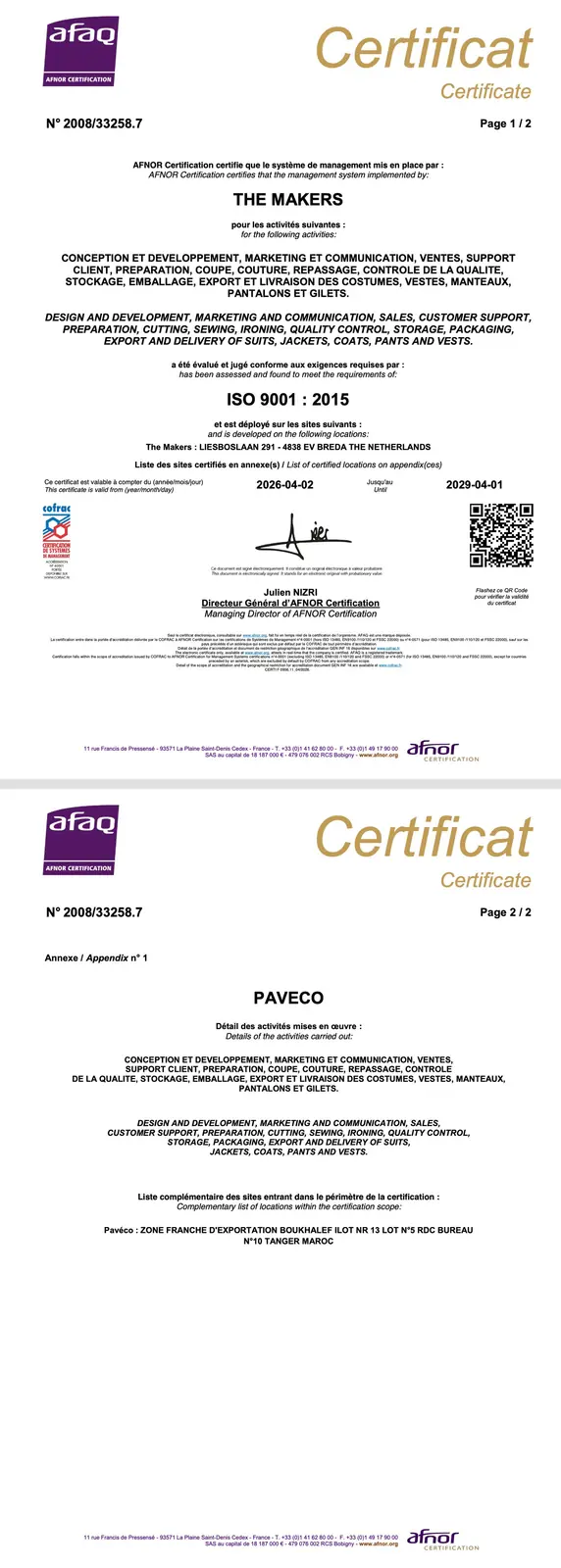
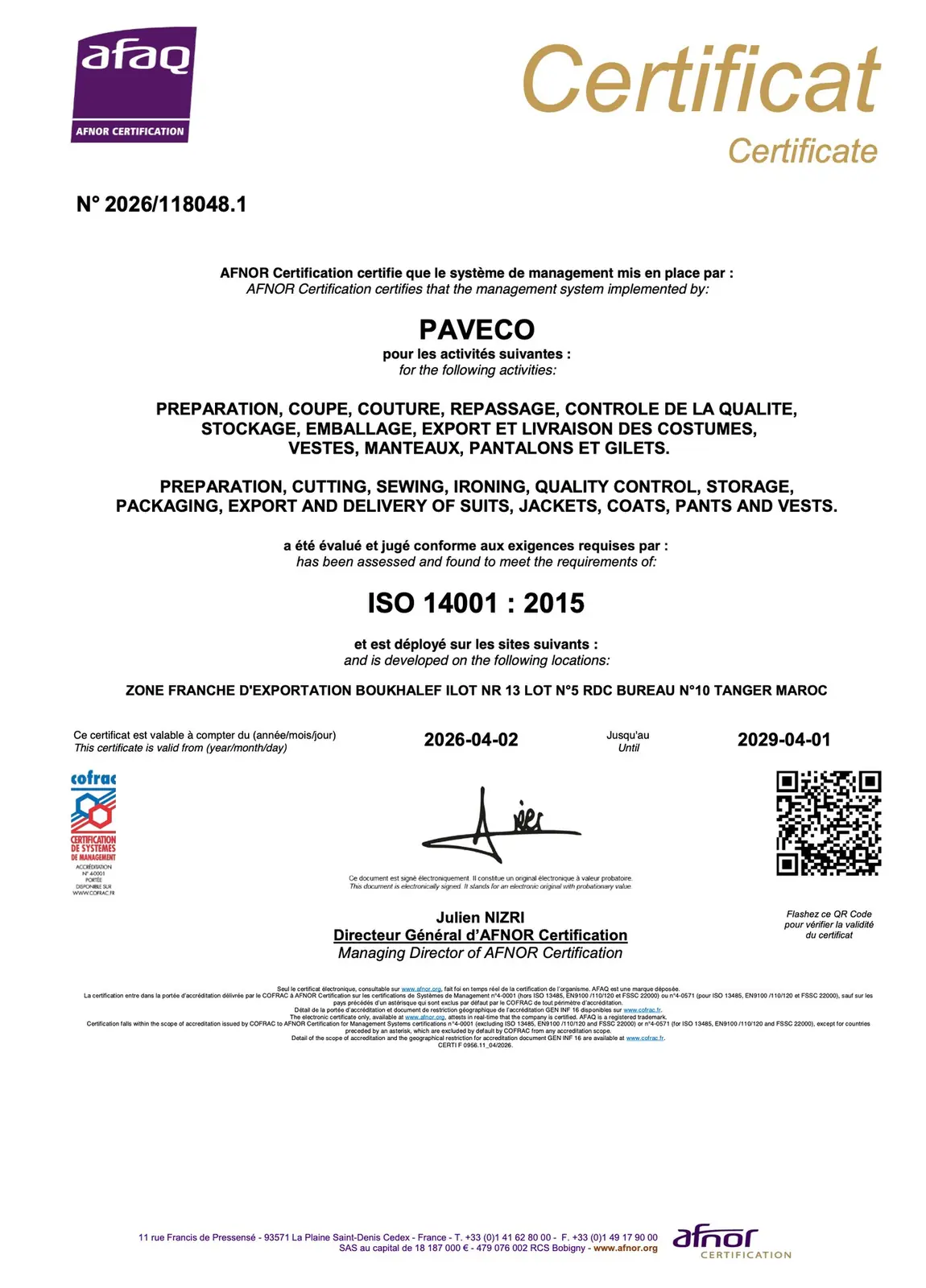
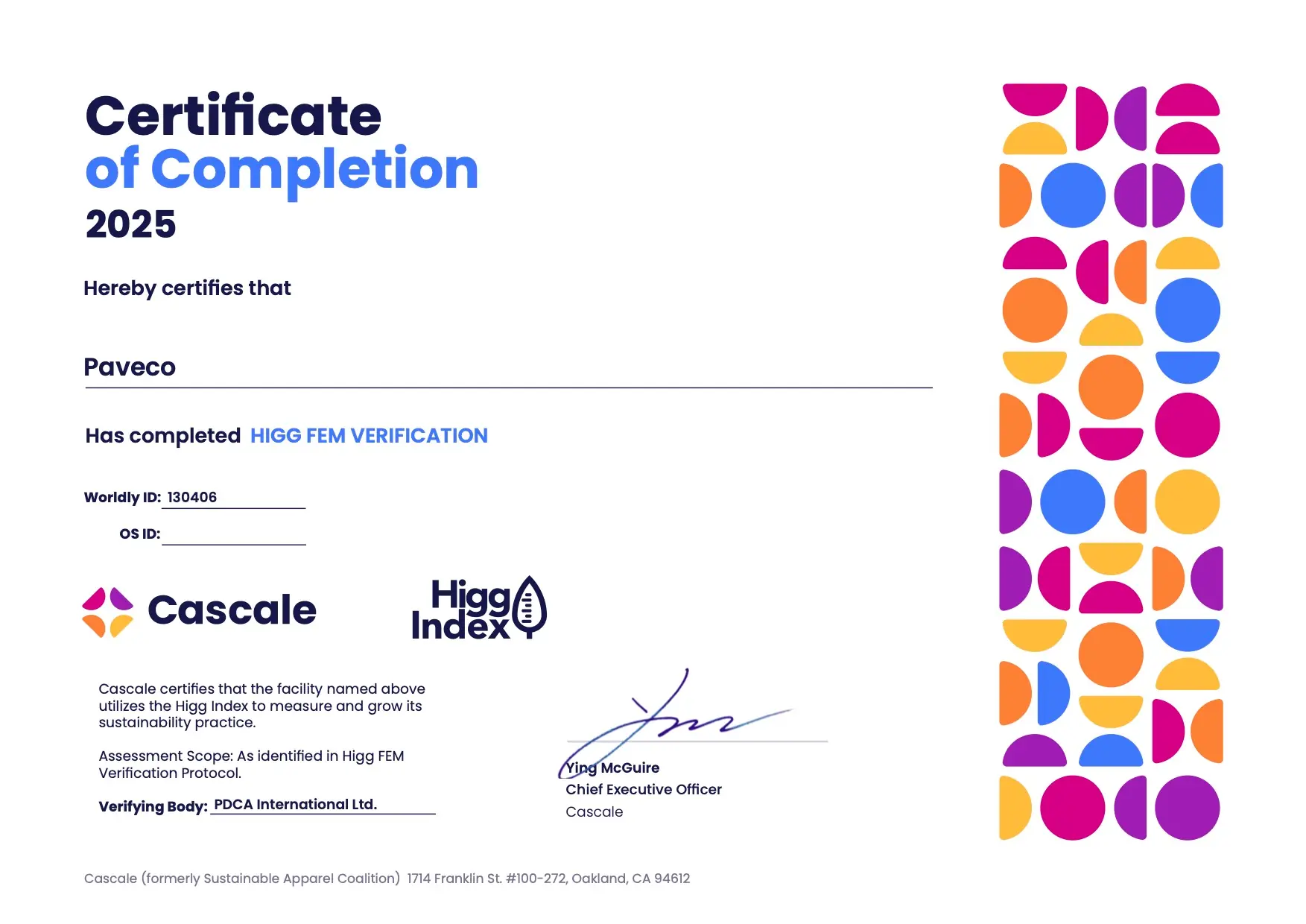
Certified management systems
Our management systems are independently assessed by accredited bodies.
Quality
ISO 9001:2015

Environment
ISO 14001:2015
Environment
FEM Certificate
Clear principles, honest boundaries
This voluntary report is intended to improve transparency and support dialogue with customers, employees, suppliers, financial partners and other stakeholders.
| Reporting period | 1 October 2024 to 30 September 2025 |
|---|---|
| Scope | The Makers’ operations in Breda and the Paveco production operation in Tangier, unless a section states otherwise |
| Approach | Prepared voluntarily, with reference to relevant GRI concepts, ISO 26000, ILO principles, the UN Global Compact, the UN Sustainable Development Goals and the GHG Protocol |
| Assurance | This report has not been independently assured |
| Data | Based on internal systems and available records. Absolute figures for electricity, fuel, water, waste and emissions will be published once units, boundaries and methods have been validated. |
Priorities for 2026
The next phase is about turning established systems and studies into measurable operational progress.
Install solar energy
Move from study and financing to implementation.
Validate carbon reporting
Confirm boundaries, factors, units and governance for Scope 1 and Scope 2, and develop Scope 3 data where material.
Advance the digital factory
Continue the digital-factory programme and improve the operational data foundation.
Reduce cutting waste
Group suitable fabric cutting and cut against actual rather than planned material requirements.
Find recycling partners
Establish viable routes for textile and other production waste.
Invest in longevity
Use technology, machinery and methods to improve consistency and garment life.
Long-term direction
By 2030, we aim to combine clean energy, decent work, responsible production and durable quality in a manufacturing model built for people, partners and long-term progress.
Let’s build responsible progress together.